
By Chris Skoff, Managing Director, Marks Baughan
My five days in London for INTA 2026 were unsurprisingly less about IP law and nearly all about market intelligence, recent and pending deals (real or imagined… quite a rumour mill), AI, and potential deal flow. We had dozens of great conversations with leaders of key IP solution providers ranging from big to small, well-funded to seeking funding, strategic acquirors, potential M&A targets, and investors. All good conversations with good people.
My three main takeaways are below, elaborated on thereafter:
Takeaway 1: The Data Moat Is the Primary Filter
Three converging signals support this:
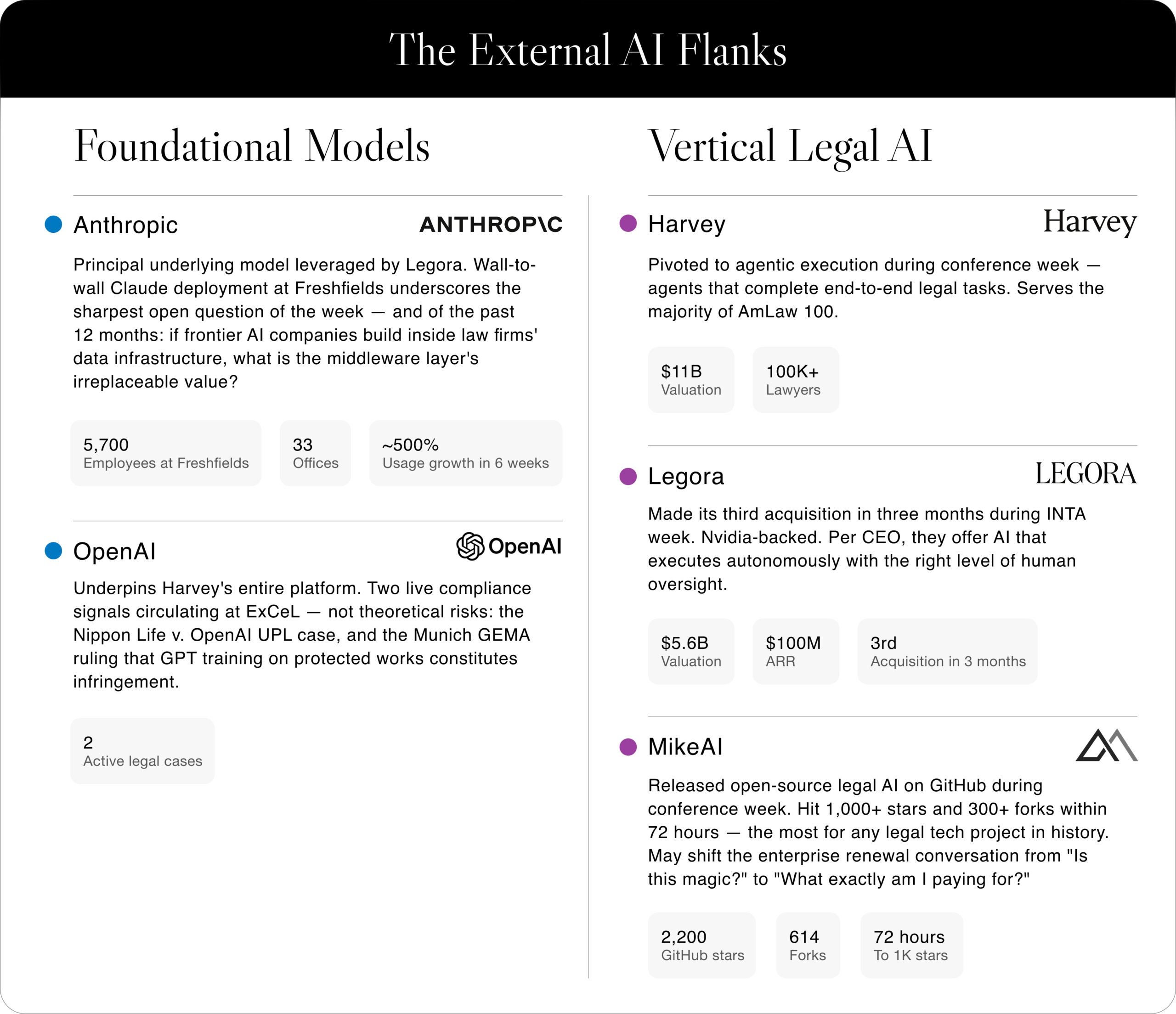
- Anthropic co-developing inside Freshfields’ institutional data
- Legora acquiring Qura explicitly for legal research data
- As one observer mused that the MikeAI announcement may demonstrate that the model layer alone is commoditizing. If the model is free, and the platform is replicable, durable differentiation lives in the data underneath.
European courts may also be raising the bar. The Munich GEMA ruling signals that AI training data provenance is a live litigation front, adding a compliance dimension to what was previously only a product argument. (Notably, OpenAI has announced plans to appeal, and the judgment is not yet final.)
All this leaves us questions to ask:
- Does the company own its training data?
- Is that data exclusive?
- Does the model improve with real-world use?
Takeaway 2: Architecture Premium Is Real
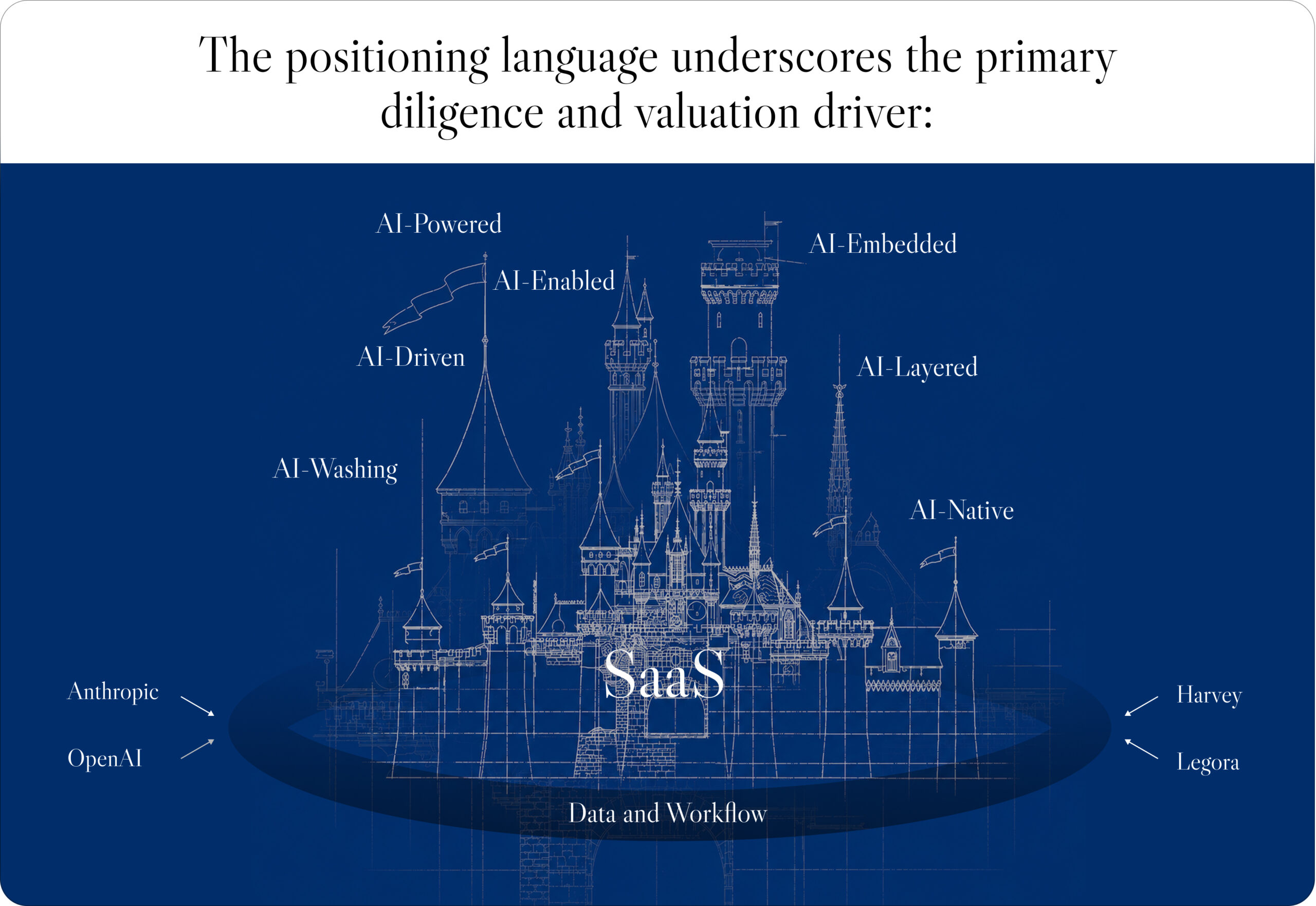
AI-native versus AI-layered is the M&A diligence question for every IPMS target. Anaqua is attempting to define the category. The valuation gap between tiers may widen materially over the next 18 months.
Takeaway 3: IP-as-Financial-Infrastructure Is the Gap the Conference Identified but Couldn’t Fill
The C-suite repositioning that was documented throughout this conference creates demand for tooling that translates IP portfolio health into the metrics CFOs and acquirers actually use. That category barely exists at scale today.
IP is being underscored, if not repositioned, as a board-level financial asset. David Haigh’s Brand Finance keynote, Investing in What You Can’t Touch but Can’t Ignore, and INTA’s own pre-conference M&A event on intangible assets and capital made clear that the buyer for IP intelligence solutions is no longer only the GC. Solutions increasingly need to address the CFO and the deal team.
The investor who backs the right platform before INTA 2027 (San Diego) will be early to a pain point the profession is publicly acknowledging it needs.
The AI Phase Shift — From Topic to Infrastructure
At INTA 2025, AI was absolutely a key topic of discussion, but at INTA 2026, AI was the primary and dominant topic. The Moderna/Expedia/3M panel seemed to deliver the headline number: 30% of legal workflows are already AI-enabled and four-hour tasks are now done in 25 minutes.
Moderna’s John Ward framed it as a “force multiplier.” Sir Colin Ian Birss, Chancellor of the High Court of England and Wales and former Lord Justice of Appeal, disclosed he uses AI to check judgments for clarity and consistency. To quote Lord Justice Birss, “It is useful and it will be used and I can tell you, I have used it.” He added, “I’m taking full personal responsibility for what I put in my judgment, I am not trying to give the responsibility to somebody else.”1 That is quite an AI adoption proof point.
The Vendor Battleground — AI-native Vs. AI-layered
For me, the most commercially important question was playing out among the exhibitors in the Innovation Marketplace: Is your AI structural to the platform, or bolted onto a legacy workflow engine? Anaqua’s acquisition of RightHub (announced just prior to INTA 2025) arrived at London this year as a live category claim — “the industry’s first AI-native IP operating system.” Questel leaned into “agentic AI workflows.”
The buyers of IP technology are getting smarter about these architecture questions. For investors and strategic acquirors in the space, this is ultimately the entire valuation question. Philosophical battle lines are being drawn among IT regimes. Simultaneously, “AI washing” is increasingly flagged as a legal and reputational risk, and practitioners applied the same skepticism to vendor booths (but, not surprisingly, “everyone else” is the culprit).
Social Media Pulse — What Caught My Eye at #INTA2026
- Birss AI disclosure: Lord Justice Birss’s admission that he uses AI to sense-check appellate judgments (May 5 session) was the week’s most-shared moment with approval from seniors, due process concern from juniors. The LinkedIn thread ran for days.
- Moderna metrics: The panel’s 30%/25-minute figures mentioned above were photographed and circulated as proof-point evidence. This was the benchmark that I heard most.
- AI-washing irony: There were sessions flagging AI-washing as a brand risk, and related discussions applied to the Innovation Marketplace floor. Posts naming the irony drove interesting engagement. (This topic was clearly on the radar prior to the conference itself, and it isn’t just a consideration in IP or legal tech more broadly, for that matter. It is a topic for all technology segments.)
- Haloo Bus. “AI-native or left behind” was a clever and effective marketing tool and message that seemed to resonate and circulate well beyond their follower base. The underlying data moat argument was amplified by MikeAI’s simultaneous open-source launch.
- Taylor Wessing merger: Roland Mallinson’s INTA-week discussion of Taylor Wessing’s pending merger with Winston & Strawn ran as a law firm consolidation subplot alongside the software M&A story. (We’ve seen growing interest in investment in law firms over the last year. Watch our on-demand webinar on law firms exploring outside investment and our sequel on securing outside investment.
Transaction Activity — April 1 – May 6, 2026
Three IP software deals closed in 35 days around INTA 2026. The deal pace itself was discussed on the conference floor. Marks Baughan Securities was the exclusive advisor to Patrix in its acquisition by Anaqua.
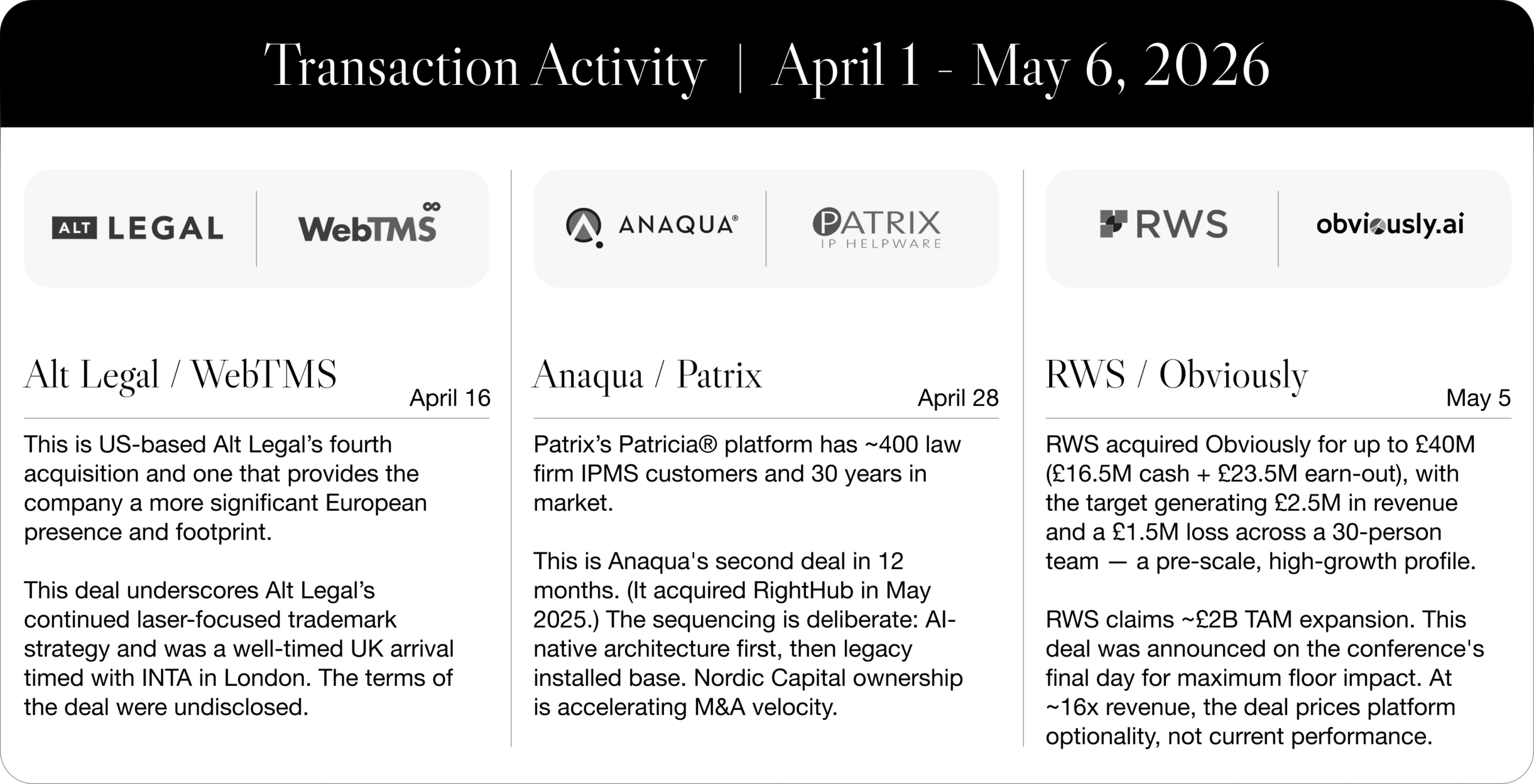
Three deals in 35 days means the remaining independent IPMS and IP-analytics platforms are operating in an active buyer market. The likely acquirers were all at ExCeL.
In closing, the architecture question is no longer theoretical, and the market is not waiting.
Any platform seeking investment, preparing for a funding round, or entering M&A conversations in the next 18 months needs to answer three questions with precision:
- Where does AI sit in your stack?
- Who owns the data underneath it?
- What , if any, defensible moat does your workflow alone provide?
Whether you are building AI-native from the ground up or defending an installed base built on SaaS workflows, the valuation dynamics may change dramatically before INTA 2027.
The buyers, the diligence teams, and the capital were at ExCeL last week. The positioning work needs to happen before the next time they convene. Answer these questions on your own terms, in advance — or have them answered for you in a term sheet.
Source:
- Farah, H. (2023, September 16). Court of appeal judge praises ‘jolly useful’ ChatGPT after asking it for legal summary. The Guardian. https://www.theguardian.com/technology/2023/sep/15/court-of-appeal-judge-praises-jolly-useful-chatgpt-after-asking-it-for-legal-summary