
By Chris Skoff, Managing Director, Marks Baughan
For decades, the intellectual property software market has been largely characterized by boundaries within legal department ownership, control, and budget. IP management software (IPMS) vendors built lasting, valuable businesses by addressing the clear need to automate patent and trademark lifecycle management for corporate legal departments and the law firms that serve them. They bridged drafting and prosecution on one side with annuities and renewals on the other, all wrapped in a system designed to reduce risk, ensure compliance, and control outside counsel spend.
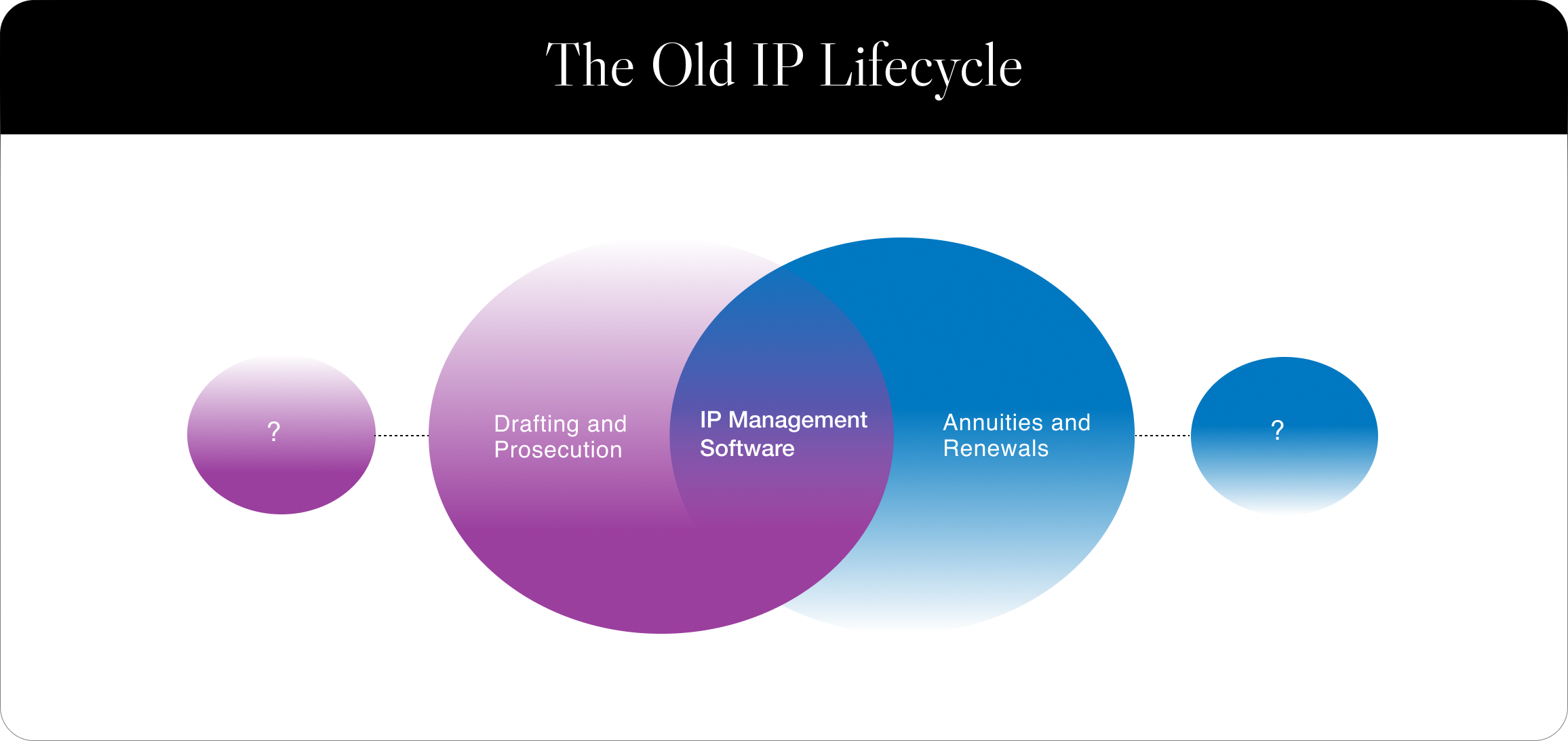
Their original value proposition stayed compelling over the years, and it’s still compelling. But those businesses have also largely remained boxed-in by both legal department budgets and buyers:
- Legal is designed to control risk, not drive growth, so spend remained tight as portfolios grew.
- Buyers focused almost exclusively on the more common registered IP — patents and trademarks — overlooking trade secrets, brands, domains, licensable copyrighted content like music, and name, image, and likeness (NIL) rights.
AI is now freeing IPMS platforms from these shackles. It’s pulling the technology left into innovation management and right into monetization and risk, while simultaneously expanding what counts as IP worth managing in the first place. The result: what was once legal-only software becomes enterprise-wide intangible-asset infrastructure, and that resets total addressable market, buyer concentration, and valuation for the entire category.
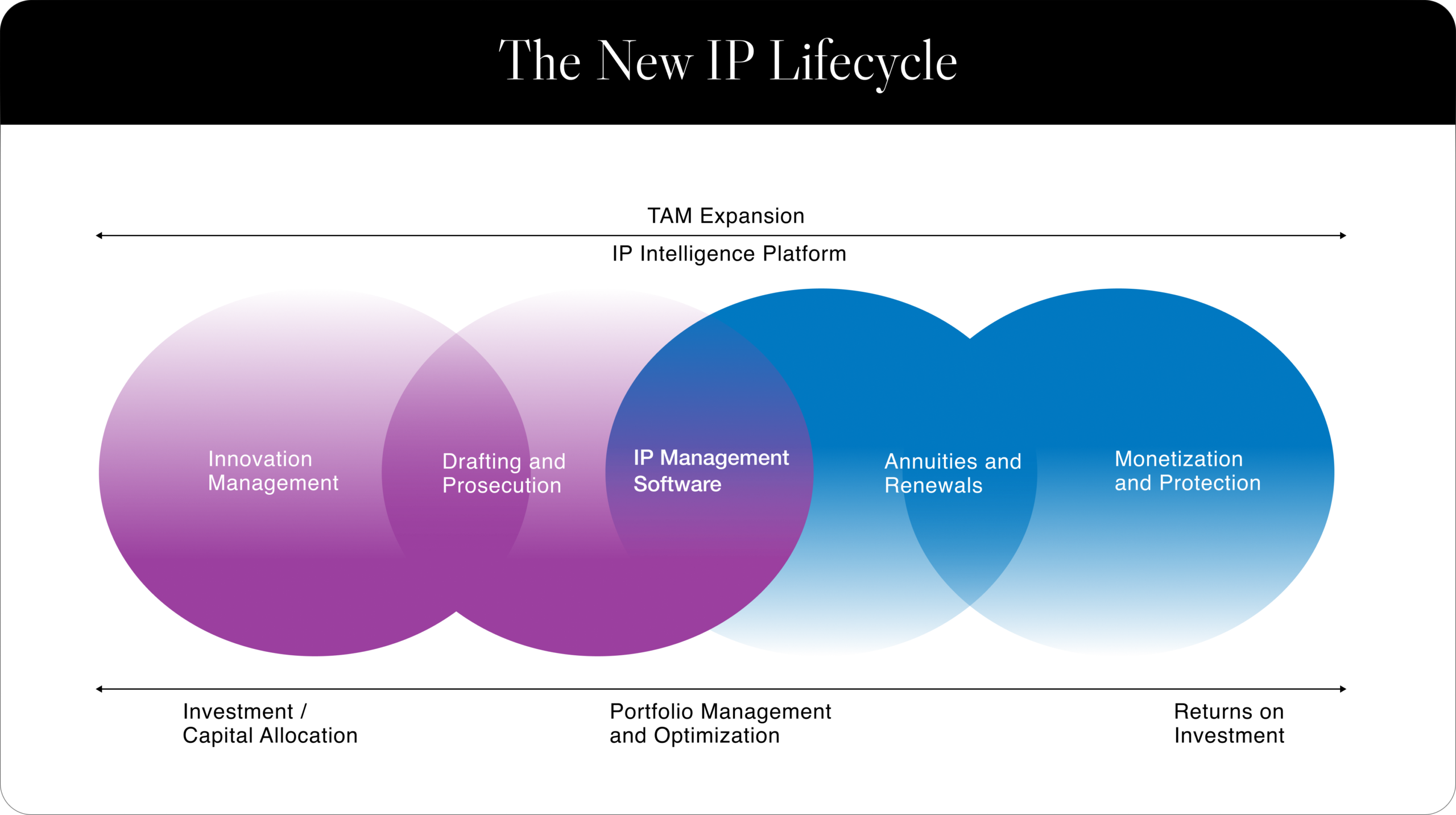
Here, we dive into this transformative shift, exploring who buys the software, what it manages, and what that’s worth to investors.
AI Is Pulling New Buyers Into the Software
IPMS once lived squarely inside the legal department, and its core value was operational:
- Track deadlines
- Manage filings
- Ensure renewals get paid
- Reduce administrative burden
- Control and optimize spend
Revenue scaled with the number of filings, the size and geography of the portfolio, and regulatory complexity, but not with company growth or innovation output because legal still controlled the checkbook even as IP platforms added capabilities like patent search, prior-art analysis, and portfolio analytics.
The Leftward Pull Into Innovation Infrastructure
AI’s most disruptive impact on IP software may be the ability to ingest unstructured data and illuminate patterns and opportunities that were previously invisible or too costly to find. Applied to IP, that capability moves software left of filing and into idea and innovation management. Instead of merely managing inventions once disclosed, AI-enabled platforms can:
- Analyze R&D documents and technical reports to bring promising new ideas to light
- Identify invention candidates earlier in the development cycle
- Reveal areas where the company could innovate ahead of competitors
- Make it easier for teams to capture and track new ideas internally
At that point, IP software stops looking like legal operations tooling and starts to resemble innovation management infrastructure — living increasingly in R&D, product, and corporate strategy, all of which have larger budgets and longer planning horizons than legal. For IPMS vendors, that’s new TAM:
- Spend moves from episodic, matter-based legal budgeting to recurring investments in R&D and innovation
- More teams use the software, increasing adoption and value across the company
- Sales motions increasingly involve leaders beyond legal, including CTOs, heads of R&D, and product leadership
The Rightward Push Into Monetization and Risk
On the other side of the lifecycle, AI is reshaping how businesses think about monetization, enforcement, and risk. IP monetization — licensing, enforcement, valuation — traditionally required heavy manual work and moved slowly. Many patent-rich organizations lacked the internal expertise or risk appetite to pursue it aggressively, leaving much of their IP portfolio underused as a financial asset. AI changes that by letting platforms:
- Continuously assess portfolio value
- Identify licensing opportunities across markets and geographies
- Prioritize enforcement based on economic impact
- Monitor infringement, misuse, and competitive threats more quickly, proactively, and accurately at scale
These capabilities pull new buyers into the conversation, including CFOs focused on asset monetization, IT and risk teams focused on threat mitigation, and strategy and corporate development teams relying on IP intelligence for M&A. The deal activity backs up this shift: non-practicing entity and patent assertion entity activity is at or near all-time highs on the offensive side, and on the defensive side Anaqua’s August 2026 acquisition of Unified Patents is exactly the kind of monetization-adjacent, litigation-risk capability this shift predicts. Fortress Investment Group’s May 2026 acquisition of IPValue Management Group also underscores how sophisticated financial investors treat IP patent portfolios as a distinct and valuable financial asset class in their own right.
AI Is Expanding the Definition of IP, and Capital Is Following the Software
IP isn’t just patents and trademarks. It extends beyond what’s legally registered to include what creates value inside the business, such as trade secrets, brands, domains, and copyright-protected content. These assets often represent a larger share of enterprise intangible value than formal IP rights alone, and they touch more departments, including marketing and digital operations. Whether IP platforms move into these broader sets of intangible assets at scale to expand their share of a far larger market for IP market remains to be seen. But these are all large market opportunities.
The capital is following the software focused on these other and unregistered IP assets. Let’s take music rights as an example. While institutional capital investing directly in music rights isn’t new, what is newer is an influx of capital investing in the dedicated software vendors that manage those rights. TA Associates and GoldState Music’s investment in Too Lost, a music distribution and publishing administration platform, and Rightsline’s $500 million growth investment from Hg in May 2026 are both bets on rights administration infrastructure. These deals underscore the thesis that the platform managing these other IP assets is becoming as valuable as the asset itself.
Entirely New Categories of Monetizable IP Are Emerging
The same dynamic is emerging from the opposite direction. Rather than capital flowing only toward existing catalogs, new categories of monetizable IP are being created outright in the “creator economy” and as NIL rights extend to college athletes and personal brand rights become central to influencers’ and celebrities’ livelihoods. The U.S. college NIL market has grown from roughly $1.67 billion in the 2024–25 academic year to an estimated $4.5 billion in 2026. The same pattern visible in music and patents is repeating here. Companies like Opendorse, an NIL marketplace and compliance platform, and Athliance, which automates NIL compliance tracking for smaller athletic programs, have collectively raised millions since 2022.
This Shift Resets Valuation Math
Multi-department reach expands TAM, whitespace, and share of wallet within each customer. Platforms that serve more teams and influence broader budgets keep customers longer, grow account value over time, and become harder to replace. The capital is chasing the innovation and monetization side of the stack rather than the legal-ops core. PatSnap, which positioned itself around R&D and innovation rather than legal ops from early on, confidentially filed for a dual IPO in Hong Kong and Singapore in 2026 targeting a valuation above $2 billion.
Ultimately, the most attractive IP software assets over the next decade will be those that support the redefining of IP inside the enterprise.
For investors evaluating that shift, three questions matter most:
- How many budget owners does this platform serve?
- Is revenue tied to cost savings, or to innovation and monetization outcomes?
- Does AI functionality drive workflow expansion, or just marginal efficiency gains?
For acquirers, IPMS increasingly represents a strategic control point for some of the most valuable data a company holds: innovation intent, competitive positioning, and intangible asset value.
The New Center of Gravity
Until now, the docket dominated the story, and IPMS was beholden to it. AI is breaking that bond. The winners will be the platforms that extend far beyond the docket to become true innovation management infrastructure — embedded throughout the identification, creation, protection, monetization, and growth of all intangible assets. From where I sit, that makes IP software one of the more underappreciated enterprise software transformation stories of the coming decade.